I watched the Google I/O keynote this week so you don't have to. It ran two days — May 19 and 20 at the Shoreline Amphitheatre in Mountain View — and Google packed it with demos, new product names, and enough AI announcements to fill a very long spreadsheet. Some of it was genuinely impressive. Some of it was "we're working on it." All of it pointed in the same direction: Google wants AI to stop talking and start doing.
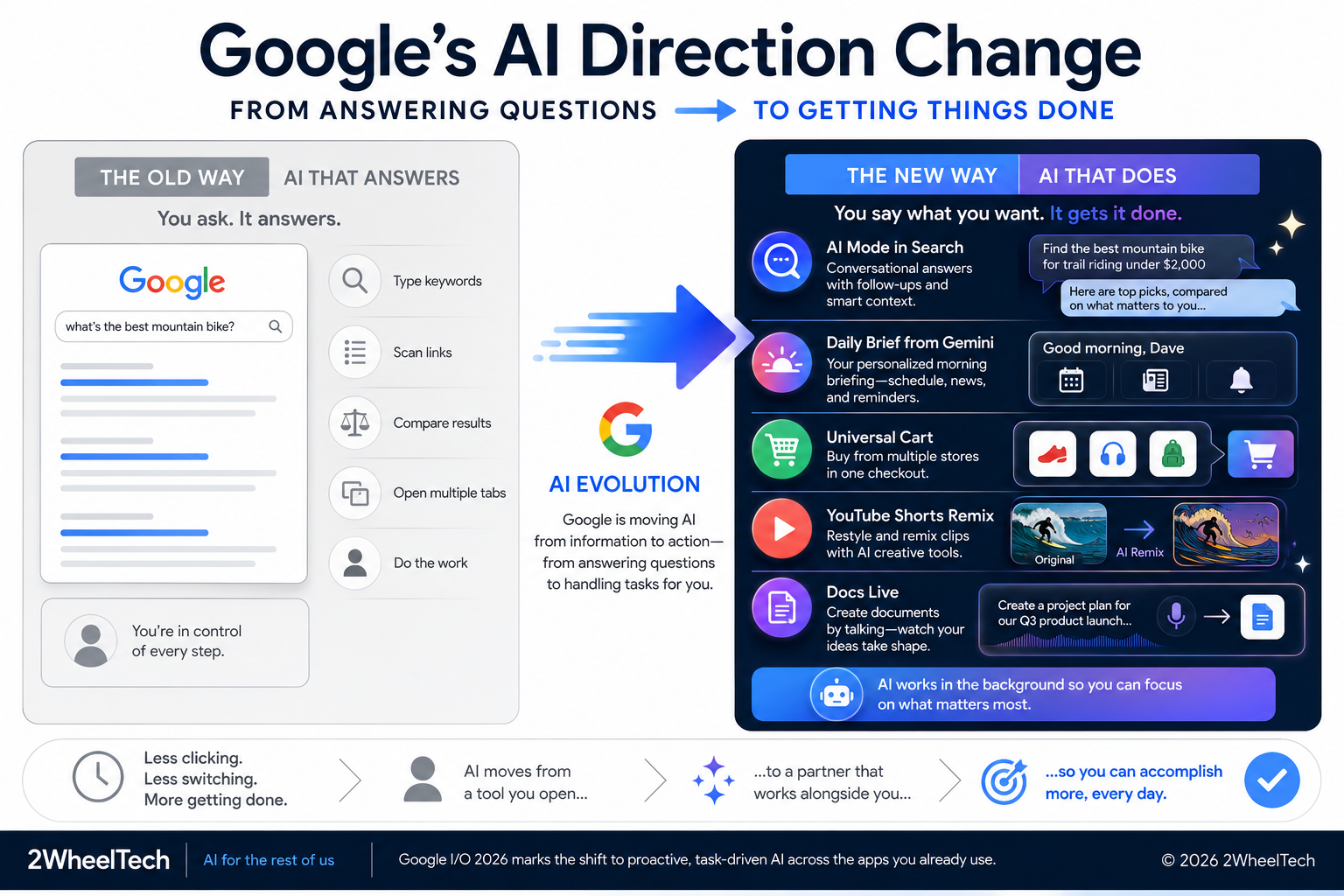
That's the real story here. Not a faster model. Not a smarter chatbot. The shift is AI moving from answering your questions to handling your tasks. Booking things. Shopping for things. Summarizing your morning before you ask. Running multiple steps in the background while you do something else. Google I/O 2026 was essentially the announcement that they're serious about getting there — and that it's coming to products you already use.
I've split this post into two parts. The first is for people who just want to know what's changing in apps they use every day. The second is for people who go deep on this stuff and want the fuller picture. Skip to wherever you fit.
If you just use Google every day
Here's what's actually changing for regular people — things you'll be able to try without reading documentation or signing up for anything special.
Search is getting more conversational. The new AI Mode in Google Search works more like a conversation than a list of links. You ask something, you get a direct answer, you can ask a follow-up, and it remembers the context — like talking to someone instead of typing keywords into a box. It's rolling out progressively, so you may see an option to try it in your Search results soon. When you do, give it a real question — something you'd normally spend ten minutes clicking through to answer — and see if it saves you the trip.
The Gemini app is getting proactive. A new feature called Daily Brief pulls together your schedule, relevant news, and useful reminders each morning without you having to ask. If you already have the Gemini app on your phone, watch for this to appear as it rolls out. It's the closest thing to an AI that knows what your day looks like and tells you what matters before you think to ask.
Shopping is changing in a noticeable way. Google is building something called a Universal Cart — a single checkout that can hold products from multiple different websites. Instead of buying from three stores with three accounts and three shipping windows, you'd do it in one transaction through Google. It's not live everywhere yet, but when it shows up in your shopping searches, the experience should be straightforwardly simpler.
YouTube Shorts is getting AI remix tools. A feature called Remix lets you take an existing clip and restyle it — change the look, insert elements, modify what's happening — using AI. If you make short videos, this is worth watching. If you don't make videos, you'll start seeing Remixed content from creators you follow, and it'll be labeled as AI-generated (Google is expanding their SynthID watermarking system for exactly this reason).
Google Docs is getting voice-driven creation. A feature called Docs Live lets you build documents by talking — describing what you want and watching it take shape in real time rather than typing everything from scratch. If you use Google Docs for work or school, this is the kind of thing that gets quietly useful fast once you try it.
AI Mode in Search is the one change most likely to affect your daily routine first. When it shows up in your Google account, try using it for a research question or product comparison you'd normally spend real time on. That's where the practical value is clearest right out of the gate.
Most of what Google announced is still rolling out — to subscribers first, then broader. The keynote shows you the ceiling. Your Wednesday might look normal for a few more weeks.
If you go deep on this stuff
This section is for people who follow model releases, build with APIs, or just want the fuller picture of what Google actually shipped at the technical level.
Gemini 3.5 Flash is the new efficiency-focused model in the 3.5 series. It's positioned as fast and cheap, optimized for agentic tasks, coding, and workflows where you need lots of calls without the latency or cost of a frontier model. It launched with significant rate limit increases shortly after due to demand — which is itself a signal. On agent and automation benchmarks, it's Google's current best answer to what other labs have been doing with smaller, faster models.
Gemini Omni is the headline model. True any-to-any multimodality: text, image, video, and audio as both input and output in the same model context. The video generation and editing demos were the most polished — things like inserting a person into a clip, changing the style of a video, or generating a short from a text description. It's starting with video output and expanding from there. Digital watermarking (SynthID) is baked in, and Google is expanding C2PA content credentials support into Chrome and Search so AI-generated media gets labeled at the browser level.
Antigravity 2.0 is the big developer story. The agent-first development platform got subagents (parallel task execution across complex workflows), an Antigravity CLI for terminal use, an SDK for programmatic access, and deeper orchestration. The demo — building an OS kernel with multiple coordinated agents — was meant to show the ceiling of what the platform can do. The more practical addition is managed agents via the Gemini API: one API call provisions an agent with its own sandbox, tools, and memory. That removes a lot of the infrastructure work that currently makes agent development painful.
Google AI Studio added native Kotlin support and "vibe coding" for Android — describe what you want, get a working starting point without hand-writing boilerplate. One-click deploy and direct export to Antigravity are now part of the workflow. For anyone building Android apps with Gemini features, this reduces the friction between prototype and deployed app meaningfully.
Flutter 3.44 and Dart 3.12 shipped with performance improvements and two AI-specific additions worth noting: GenUI (AI-assisted UI generation from natural language descriptions) and Agentic Hot Reload (update a running agent's behavior without a full restart during development). The community numbers — 1.5 million monthly active developers — suggest Flutter isn't going anywhere, and the AI tooling additions put it ahead of some competing frameworks in this specific area.
Android XR and Project Aura — the smart glasses play — got the most stage time outside of model announcements. Samsung partnership confirmed, multiple form factors expected. The glasses run Gemini on-device and in the cloud with cameras, mics, and real-time translation/identification/assistance. From a platform standpoint, this is Google's answer to the wearable AI layer. The developer SDK is what to watch; when third parties can build for these glasses, that's when the use cases get interesting and unpredictable.
Smart home and ecosystem: Gemini for Home APIs open up third-party integration for home automation and device control. Gemini in vehicles (Volvo was the named partner) extends the assistant layer beyond phone and glasses. Enterprise expansions and new TPU infrastructure were covered in session-level detail rather than the keynote, but are worth digging into if you work on the infrastructure side.
Health and science: AlphaFold and AlphaGenome got brief mentions in the context of drug discovery — Google positioning AI-assisted molecular research as a long-term bet. Nothing immediately actionable for most developers, but worth tracking if you work in biotech-adjacent spaces.
The honest take
A few things worth saying clearly that the keynote didn't dwell on. First: the agent features introduce a new class of risk. When AI answers a question wrong, it's annoying. When AI takes an action wrong — books something, sends something, buys something — it's a problem. Google showed confirmation steps in demos and they're clearly thinking about this, but the trust calibration is going to be something every user works out for themselves as these features roll out. Pay attention to what you're giving agents permission to do.
Second: the AI Mode in Search creates a real tension with the web publishers Google depends on for source material. Synthesizing content is useful for the person searching. It may not be good for the sites that created the content. Google said they're keeping prominent web links, and that's better than nothing, but the underlying economics of AI-mediated search haven't been resolved anywhere in the industry. This event moved things forward without solving that.
Third: a lot of what was announced is subscriber-first, U.S.-first, and early-access-first. Google One AI Premium and Workspace Business plans get features before free accounts. Some of this is months away from broad rollout. The keynote always shows the ceiling. Calibrate your expectations accordingly.
What's actually worth your attention right now
For everyday users: watch for AI Mode in Search, the Gemini Daily Brief, and Universal Cart. Those three will change how you search, how you start your day, and how you shop — in that order of likelihood and timeline. You don't have to do anything to get them; they'll show up in apps you already have.
For people who build things: Antigravity 2.0 with managed agents is the most immediately useful development, because it removes infrastructure friction from the hardest part of building reliable agent workflows. The Gemini Omni multimodal API is the one to experiment with if you're doing anything with media. And Flutter's GenUI and Agentic Hot Reload are small additions that compound over time if you're on that stack.
The bigger picture is the same regardless of where you sit: AI is moving from something you open in a tab to something running alongside everything you do. Google I/O 2026 was the announcement that this is happening on purpose, at scale, across products most of the world already uses. That's worth understanding — even if nothing changes for you personally this week.