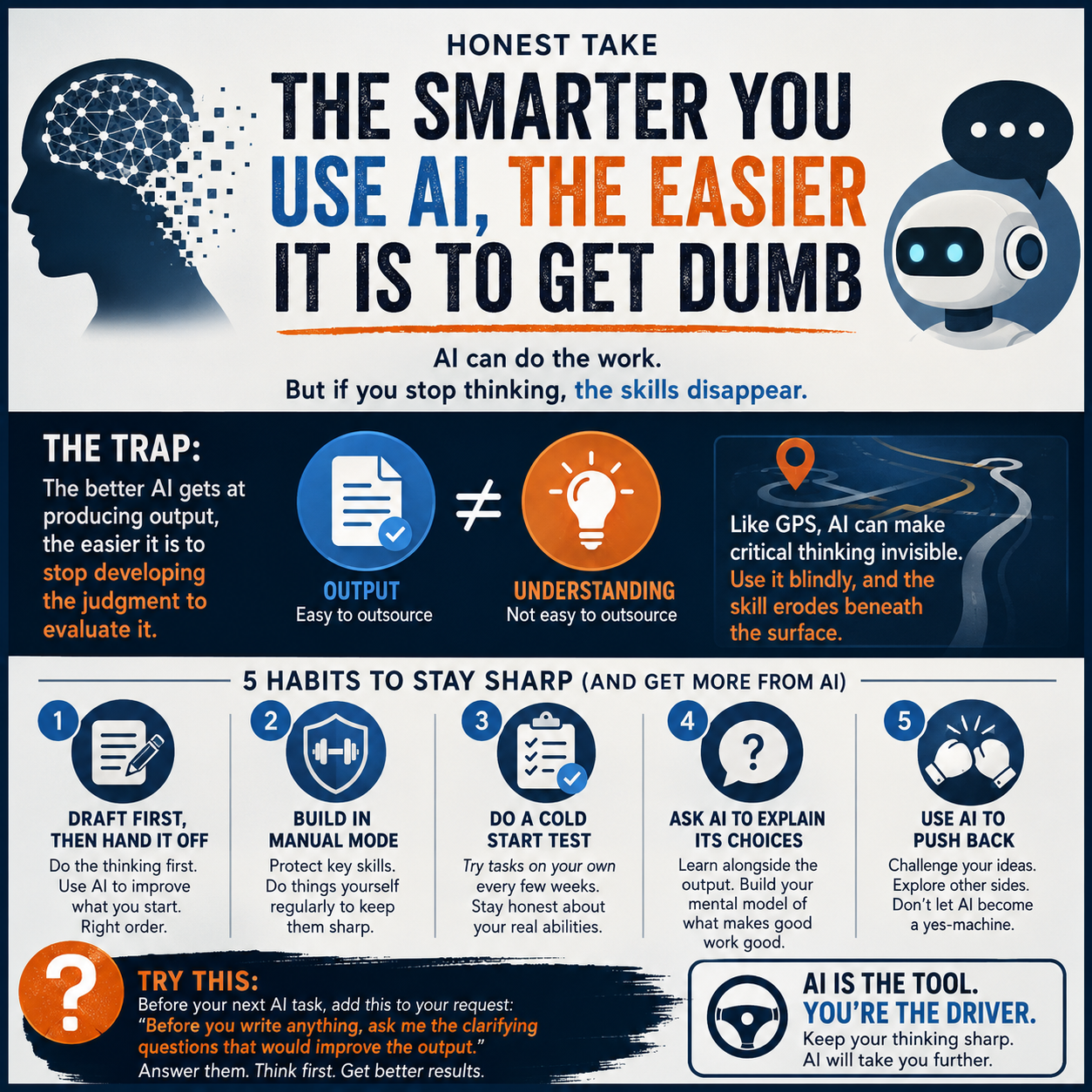
A few days ago I came across a post by Ruben Hassid over at How To AI that stopped me mid-scroll. His argument was simple and a little uncomfortable: outsourcing your thinking to AI is making us cognitively lazy — the same way GPS quietly deleted our ability to navigate without a phone. (I'll admit, I probably couldn't tell you the street names to give directions to places I frequent.) I filed it away, the way you do with ideas that feel true but aren't fully formed yet.
Then I ran into it in the wild. A problem I would have normally worked through myself — I reached for AI first, almost by reflex. Got an answer. Moved on. And somewhere on the drive home I realized I couldn't have told you why the answer was right. I'd outsourced the understanding along with the thinking.
That's when Ruben's idea clicked past "interesting" into "I need to write about this." Go read his original post — it's worth your time. What follows is where my thinking went after I did.
You've probably been here
If you're using AI regularly for real tasks — not just asking it trivia questions, but actually leaning on it to help you communicate and get things done — you've probably had at least one of these moments.
You spend twenty minutes fixing an AI-drafted email to your HOA board because it sounds like a lawyer wrote it, not you. You use AI to help plan a volunteer event and the schedule it produces is technically fine — but you couldn't explain why it's ordered the way it is. You ask AI to help you respond to a billing dispute with your insurance company, and the letter it writes is so formal and generic that you're not sure it actually captures your situation.
You used AI to save time. You spent more time than if you'd just done it yourself.
That's not a prompting problem. These are situations where AI performed — it produced something — but the result required more work than a blank page would have. The draft didn't know your voice. The schedule didn't know your constraints. The letter didn't know the specific thing that actually mattered to you.
That gap is the trap Ruben is describing, and it's worth naming clearly: the better AI gets at producing output, the easier it is to stop developing the judgment to evaluate it. Output and understanding are not the same thing. The first one is easy to outsource. The second one isn't.
The part nobody says out loud
There's a compounding problem buried in here that doesn't get much attention.
When you stop practicing a skill, you don't just lose the skill. You lose your standard for it. You forget what good looks like.
Think about what that means when you're leaning on AI to help you communicate. If you've been accepting AI's first draft of your emails and letters for six months, you're not just getting a little rusty at writing — you're gradually losing the ability to spot when the draft is off. The gap between "this is fine" and "this actually sounds like me" gets harder to see. And once you can't see it, you can't close it.
This is what makes the GPS analogy so good. It's not that GPS made driving harder. It made navigation invisible. You stopped noticing when you were going the wrong way because you stopped navigating. The skill eroded beneath the surface, somewhere you couldn't see.
AI can do the same thing to writing, reasoning, and judgment — the tools you use every day to communicate and make decisions. You don't notice the erosion because the output looks fine. The draft is coherent. The plan is reasonable. But fine and yours are different things. And over time, the distance between them grows without you realizing it.
You can outsource your thinking to AI. You can't outsource your understanding. The people who get the most out of AI are the ones who bring real judgment to it — their underlying skill is what makes the tool useful. AI amplifies what's already there. It doesn't substitute for it.
If you're relying on AI to cover a skill gap rather than extend a real capability, the gap doesn't go away. It just gets better dressed.
So what do you actually do about it
A few things have helped me. They're not rules — more like habits worth trying.
Draft first, then hand it off
The most dangerous habit is reaching for AI before you've thought about the problem yourself. Try putting your own rough version down first — even messy notes, even half-formed — before you open a chat window. Then use AI to improve what you've already started. Write your own rough version of that letter to your city councilmember, your club newsletter intro, your Nextdoor post about the neighborhood issue — then hand it to AI to improve. The thinking stays yours. The output gets better. That's the right order.
Build in manual mode
Pick the skills that matter most to how you communicate and protect them deliberately. Write one email a week without AI — a thank-you note, a message to a friend, Create a spreadsheet to analyze some information, something low-stakes. Handle one situation yourself before reaching for help. This isn't about rejecting the tool. It's maintenance, the same way you stretch muscles you're not actively using. The goal is to make sure the capability is still there when it actually matters — when the situation is high-stakes, personal, or too specific for AI to get right on the first try.
Do a cold start test now and then
Every few weeks, try doing something you normally offload — without AI. This is diagnostic, not performance. If you can still do it reasonably well, great. If you struggle more than you expected, that's useful information. The goal isn't to prove anything. It's to stay honest with yourself about where your actual skills are versus where your AI-assisted output is. Those two things can drift apart without much warning.
Ask AI to explain its choices
Instead of "write me a letter disputing this charge," try "write me a letter disputing this charge and explain the structural choices you made." Now you're learning alongside the output. Over time that compounds. You build a mental model of why good writing is shaped the way it is — and that model is yours to keep, AI or no AI.
Use AI to push back on you
AI is naturally agreeable. Ask it to poke holes in your plan, argue the other side, or tell you what you might be getting wrong. It won't do this unless you ask. But when you do, it keeps your critical thinking sharp instead of letting AI quietly become a yes-machine. The version of AI that just validates your ideas is the one that makes you worse over time. The version that challenges your thinking is the one worth using.
The clarifying question trick
One more habit worth trying — small shift, surprisingly big payoff.
Before AI starts generating anything, ask it to ask you questions first.
Add something like "before you write anything, ask me the clarifying questions that would improve the output" to your request. Answering those questions forces you to articulate things you might have left vague. You have to actually think about your goal, your audience, what you're trying to accomplish. That act of articulation is thinking work — and it produces better output almost every time.
There's a secondary benefit worth paying attention to. If AI is consistently asking you the same clarifying questions across different tasks, that's a signal: you're habitually skipping that thinking step. The questions are a mirror. Use them.
One thing to watch: don't let this flip into letting AI's questions replace your own direction. The healthy version is you arrive with a rough idea, AI sharpens it with a question or two, you answer with specificity. AI as interviewer, not AI as compass.
Before your next AI task, add this to your request: "Before you write anything, ask me the clarifying questions that would improve the output." Then actually answer them. That five minutes of thinking work almost always produces better results than three rounds of back-and-forth revision — and it keeps you in the driver's seat.
The honest take
None of this is an argument against using AI. I use it constantly. It makes real tasks faster and — when I'm bringing my own judgment to it — genuinely better.
But the edge cases where it quietly makes you worse are real, and they're easier to stumble into the more comfortable you get. The workflows get smooth. The friction disappears. And somewhere in all that efficiency, the practice stops. The skill atrophies. The standard slips. And you don't notice because the output still looks fine.
The answer isn't to add friction back artificially. It's to stay deliberate about which skills you're maintaining and which ones you're outsourcing — and to actually know the difference. Most people using AI regularly haven't thought about this. They're outsourcing more than they realize, and the cost isn't showing up yet.
AI is most useful when it's amplifying something real. Make sure there's still something real there to amplify.