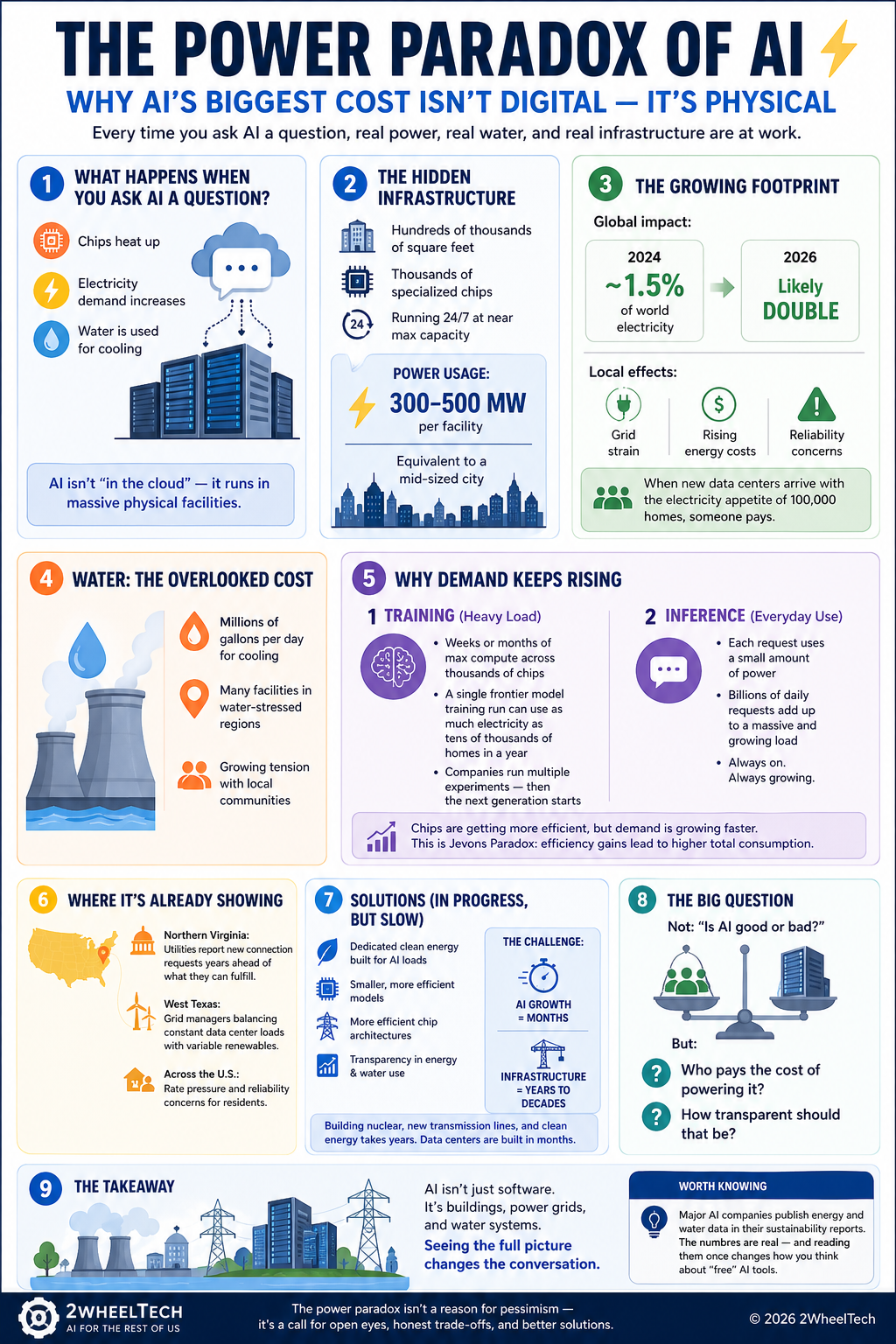
The next time you type a question into an AI chatbot, picture this: somewhere, in a building the size of several city blocks, thousands of specialized chips just got a little hotter. Cooling systems kicked on. More electricity flowed in. A small amount of water evaporated into the air.
That's not a warning. It's just the physics of what happens when you ask AI a question in 2026. And until recently, almost nobody in the mainstream conversation about AI was talking about it.
The footprint nobody was counting
For the past few years, almost the entire public conversation about AI has been about what it can do — write, reason, generate, create. That conversation is important. But it's been almost entirely digital: capabilities, risks, jobs, bias. What's been missing is the physical side of the equation.
AI runs on hardware. Hardware runs on electricity. Electricity and heat require water to manage. At the scale AI has reached in 2026, those physical requirements are large enough that treating AI as a purely digital phenomenon doesn't hold up anymore. The infrastructure is real, the grid pressure is real, and the water use is real — and they're worth understanding even if you never intend to build a data center.
What's actually powering your queries
The phrase "server farm" doesn't do justice to what a major AI facility looks like in 2026. These are purpose-built campuses — measured in hundreds of thousands of square feet — packed with racks of specialized chips running at near-maximum capacity around the clock. Not general-purpose computers, but hardware designed for one job: doing the kind of matrix math AI requires, as fast as physically possible, without stopping.
A single large facility can consume as much electricity as a mid-sized American city — somewhere in the range of 300 to 500 megawatts of continuous draw. That number isn't theoretical. Microsoft, Google, and Amazon have each disclosed facilities in that range, and the industry is building more. Think of it this way: every time a major AI company announces a new model, somewhere a new power contract is being negotiated to train it.
Where it's already hitting home
In Northern Virginia — home to the largest concentration of data centers on earth — local utilities have publicly stated that new connection requests are running years ahead of their ability to fulfill them. In West Texas, where cheap wind power attracted data center operators quickly, grid managers have had to rethink how they handle large, constant industrial loads sitting alongside variable renewable generation.
Worldwide, data centers accounted for roughly 1.5% of total electricity consumption in 2024. By 2026, that figure has very likely doubled, as the compute required to train new frontier models has grown substantially and the number of inference queries — every search, every chatbot conversation, every AI-generated image — has grown faster still. The part that gets the least attention is what this means for people already on the grid. When a new industrial neighbor arrives with the electricity appetite of a hundred thousand homes, and the grid wasn't built to absorb it quickly, someone pays for that gap. Often it's residential customers, in the form of rate pressure and reliability concerns.
Water compounds the problem. The chips generating all that computation produce tremendous heat, and most large facilities use water-based cooling systems that can consume millions of gallons per day. Several of those facilities are in water-stressed regions — parts of the American Southwest and Southeast — where local governments and communities have started asking pointed questions about who authorized that water use and for how long.
You can look up data center electricity and water disclosures for the major AI companies in their annual sustainability reports. Google, Microsoft, and Amazon publish these. The numbers are real, and reading them once changes how you think about "free" AI tools.
I've compiled both sets of sustainability report data as spreadsheets you can filter and explore yourself — direct links, key metrics, and third-party verification status all in one place.
- AI Companies — Sustainability Reports 2025 OpenAI, Google DeepMind, Anthropic, Meta AI and others · report links, renewable energy %, net zero targets
- Cloud & Hosting Infrastructure — Sustainability Reports 2025 AWS, Azure, Google Cloud, GPU clouds, and colocation providers · PUE, water use, key AI clients
Why it keeps growing even as chips get better
There are two distinct ways AI consumes energy, and understanding both explains why demand keeps rising even as individual chips become more efficient. Training is the first phase — when a company builds a new model from scratch. It requires weeks or months of continuous, maxed-out compute across thousands of chips running simultaneously. A single frontier model training run can use as much electricity as tens of thousands of homes consume in a year. Companies run multiple training experiments before landing on a final model, and then the next generation starts.
Inference is everything that happens after — every query you run, every document you summarize, every image that gets generated. Each individual inference request is cheap compared to training. But multiplied across hundreds of millions of daily users, the cumulative load is substantial and growing continuously. The chips are getting more efficient. The problem is that the appetite for using them is growing faster than the efficiency gains, so the net energy demand keeps climbing. This is sometimes called the Jevons paradox in energy economics: efficiency improvements that lower the cost of using something tend to increase total consumption of it.
The problem isn't that AI is wasteful by design. It's that every improvement in efficiency gets absorbed by new demand. We're running faster and still moving in the same direction.
The honest take
The solutions exist on paper. More energy-efficient chip architectures, smaller models that can do useful work with a fraction of the compute, dedicated clean energy infrastructure built specifically for AI loads rather than borrowed from the residential grid — real work is happening in all of these directions. But the timeline for meaningful results is slower than the timeline for growth.
Building a nuclear facility takes a decade. Permitting new transmission lines can take years. Meanwhile, hyperscalers are announcing new data center campuses on timelines measured in months. The uncomfortable truth is that for the next several years, a meaningful portion of the electricity powering AI will come from whatever source is cheapest and most available — which in many regions still includes coal and natural gas. Some of the clean energy capacity that was planned for residential decarbonization is instead being contracted to serve data centers. That's not a reason to stop building AI. It is a reason to be clear-eyed about the actual trade-offs rather than assuming the market will sort it out before the consequences land.
What changes when we see the full picture
Treating AI as a purely digital phenomenon has let a lot of physical consequences go unexamined. Once you see the infrastructure — the buildings, the power lines, the cooling towers, the water permits — the conversation changes. The question becomes less "is AI good or bad" and more "who bears the cost of building it, and how do we make sure those costs are fairly distributed and honestly disclosed."
The answers will come from a few directions: requiring AI companies to build dedicated clean energy capacity rather than drawing from existing public grids; transparency standards that treat energy and water use the same way we treat emissions disclosures; and continued investment in smaller, more efficient models that make useful AI possible without requiring a small power plant for every data center. The power paradox isn't a reason for pessimism — the friction it creates is already forcing real innovation. But the conversation needs to happen in the open, which means the rest of us need to know it's happening at all.