Last month I had a conversation with a colleague still in the corporate world. She had just spent forty-five minutes re-checking a research summary an AI had written for them. Not because the AI had obviously gotten something wrong. Because they couldn't tell whether it had.
That's a new kind of problem. And it's one I keep running into — not just with clients, but with people I know who are smart, tech-adjacent, and increasingly worn down by a technology that's supposed to be making their lives easier.
Why this feels different
AI has moved faster than almost anything else in recent memory. New models, new tools, new interfaces — every few weeks, something shifts. That would be manageable if everyone were keeping pace. But most people aren't in tech. They're in it — using it at work, bumping into it on their phone, hearing about it at the dinner table — but they didn't sign up to become early adopters, and nobody asked them.
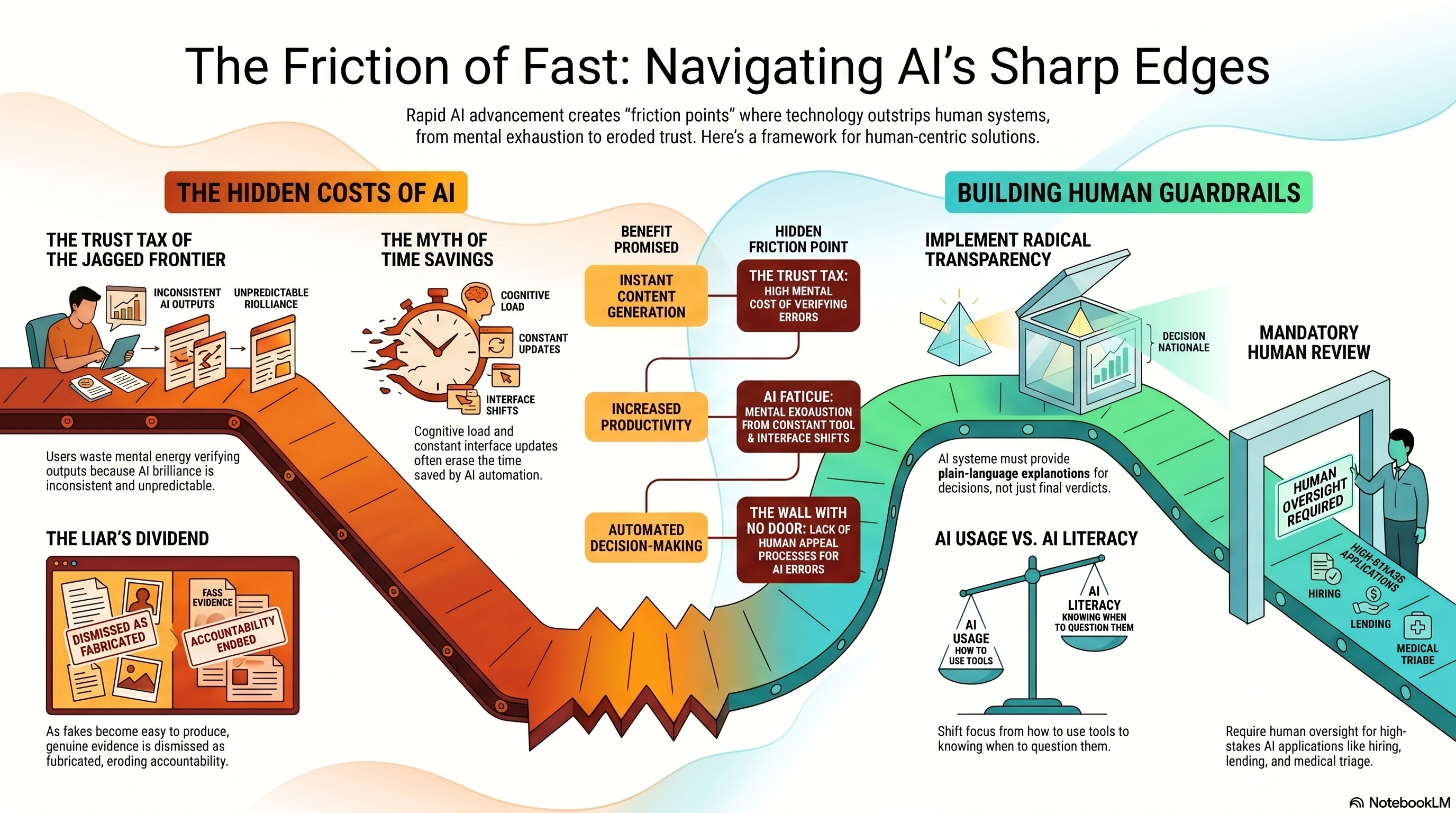
The result is a set of friction points that don't get much coverage. Not failures of AI. Not the end of civilization. Just the sharp edges that show up when technology moves faster than the people, systems, and norms built around it. I want to name four of them — because naming them is the first step to doing something about them.
When brilliant isn't enough
Researchers at Harvard Business School described something they call the "jagged frontier" of AI capability. The concept is this: AI doesn't have a clean line between what it can and can't do. The edge is jagged. A model might handle a complex financial analysis with ease, then stumble on a basic question about dates or simple logic. The capabilities are uneven in ways that aren't obvious from the outside — and that's the problem.
For regular users, this creates what I think of as a trust tax. Every time you use an AI tool, you're spending a small amount of mental energy deciding whether to believe the output. That's fine when the stakes are low and mistakes are obvious. But when the result looks confident, sounds right, and is wrong in a subtle way, the tax gets expensive fast. You end up doing more verification work than you would have before the AI existed — which is a strange outcome for a tool sold on saving time.
The issue isn't that AI makes mistakes. Everything makes mistakes. The issue is that AI mistakes often look exactly like AI getting it right.
When seeing isn't believing anymore
Legal scholars Nina Wang and Bobby Chesney coined the term "liar's dividend" back in 2018, and it describes something that has gotten considerably more relevant since then. When convincing fakes become easy to produce — video, audio, images that look and sound real — a secondary problem surfaces: genuine evidence gets dismissed as fabricated. The dividend goes to whoever wants to avoid accountability.
You see this play out in ordinary places. A real recording shows up in a group chat. Someone says it's AI-generated. Nobody can disprove it quickly enough. The moment passes, and so does the accountability. This isn't only a concern for major news events — it's corroding small, everyday trust in local communities and family conversations. The erosion of that kind of trust is hard to measure and harder to repair.
Before sharing something that looks alarming or hard to believe, slow down for sixty seconds. Search the claim, check the source, or run the image through a reverse image search. You won't catch everything — but slowing down the spread matters more than getting it perfect.
The exhaustion nobody's naming
AI is supposed to save time. And sometimes it does. But the same person who saves twenty minutes summarizing a document might spend thirty minutes the next week re-learning a changed interface. Or figuring out why an AI agent did something unexpected. Or explaining the new tool to a colleague because someone has to be the one who figured it out. The net time savings are real but smaller than advertised, and the cognitive cost is higher than most people expected.
Researchers studying workplace technology adoption have started using the phrase "AI fatigue" for this. It's not technophobia or resistance to change. It's the genuine mental weight of adapting to a technology that updates faster than a person can reasonably keep pace with. And it creates a version of the digital divide that's less about who has access to technology and more about who has the bandwidth to keep up with it. That second gap is widening — quietly, and without much acknowledgment from the people building the tools.
The wall with no door
When an AI system makes a consequential decision — filtering a job application, denying a loan, flagging an account for review — the standard human process for contesting a mistake stops working. There's often no manager to escalate to. No clear explanation beyond a code or a score. No appeal process designed for a decision that no human actually made. The customer service rep you reach by phone often can't see the reasoning either, because the system made the call and the system doesn't explain itself.
This isn't entirely new — automated systems have been making these decisions for years. But the speed and scale at which AI now touches consequential moments in people's lives has made it more common and harder to route around. People feel the loss of agency — that sense that a decision was made about them, by something, and there's nobody to talk to about it. That's a real cost, and treating it as a minor inconvenience misses what's actually at stake.
The honest take
None of what I've described is solved by individual behavior changes. Telling someone to "be more media literate" doesn't address the liar's dividend at scale. Better prompting techniques don't fix the cognitive load of a platform that rewrites its interface every six weeks. These are structural problems, and they need structural responses — from the companies building the tools and the policymakers who set the rules around them.
The frustrating part is that too much of the public conversation is still stuck in the wrong gear. Either AI is going to end civilization, or it's just a glorified search engine. Both framings miss the actual hard part: the practical friction landing on ordinary people right now, as technology runs ahead of the systems meant to hold it accountable.
A guide for the perplexed
The answer isn't slowing the technology down — that's not realistic, and the genuine benefits are real. The answer is building what I'd call human guardrails: specific, practical things that make the friction manageable rather than invisible. Radical transparency from AI systems — plain-language explanations of decisions, not just verdicts. Mandatory review periods before AI is used in high-stakes settings like employment, lending, or medical triage. And a deliberate shift in how we talk about AI education — less "here's how to use this tool," more "here's how to think about what this tool is doing and when to question it."
AI literacy and AI usage are not the same thing. Knowing how to run a prompt is different from knowing when to push back on the output. The gap between those two things is exactly where most of the sharp edges live — and closing that gap is work worth doing.