Something shifted in 2024. Not gradually, the way technology usually moves — a dial slowly turning — but in jumps. The kind you notice on a Tuesday afternoon trying to write a work email, or on a Sunday morning pulling together a church announcement, or when your teenager uses AI to explain their chemistry homework and then turns around and teaches you something.
I've been paying close attention to this space for a few years, and I'm usually the skeptic in the room. I don't love hype. I get annoyed by headlines that treat every new model like a moon landing. But 2024 into 2026 has been genuinely different — not because the technology press said so, but because the evidence started showing up in my own day-to-day work in ways I didn't expect.
This post is my attempt to make sense of it. Not a breathless announcement that AI will change everything. More like: here's what actually shifted, here's what it means for normal people, and here's the honest version of what's still messy.
The pace was real, and it didn't slow down
In 2023, the conversation was still mostly about whether large language models were "real" intelligence or just fancy autocomplete. That debate isn't gone, but it's become beside the point. By 2024, the models stopped being an interesting topic and became an infrastructure layer — like arguing about whether the electricity in your outlet is "real" power.
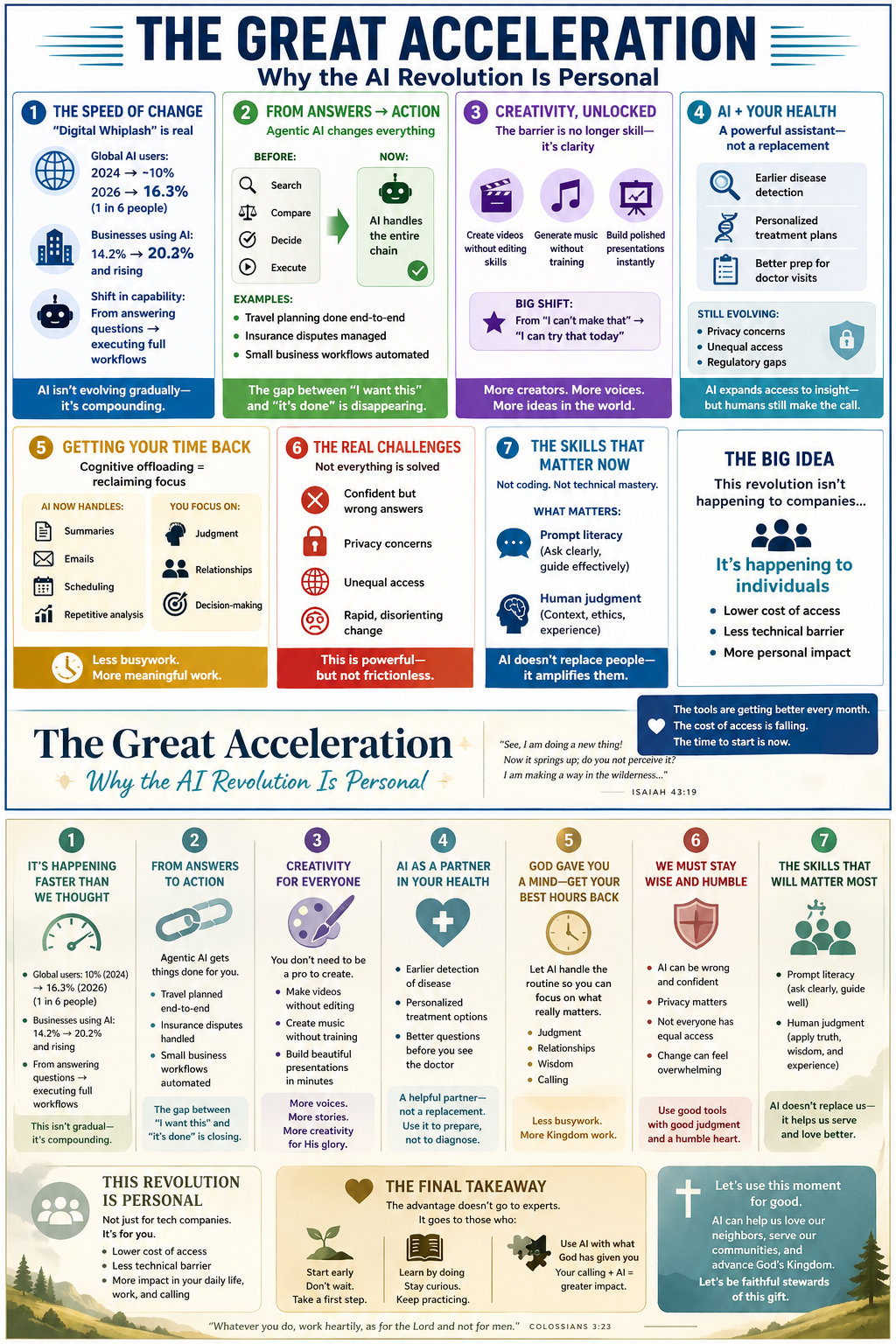
GPT-4o, Claude 3, Gemini 1.5, Llama 3, Claude Sonnet, Gemini 2 — each generation was meaningfully better than the one before. Not in ways you had to squint to see. In ways you noticed the first time you used them. Multimodal capability — the ability to work with text, images, audio, and video together — went from a research preview to a standard feature in under 18 months. Reasoning ability, the capacity to work through multi-step problems with actual step-by-step logic, became a standard feature in 2024. The biggest models now catch errors in their own thinking and correct course mid-response.
And 2026 hasn't slowed down — if anything, it's accelerated. There's a joke making the rounds that pretty much sums it up: go to bed, wake up, catch up on major AI updates, repeat daily. It's barely an exaggeration. Most weeks bring at least one announcement that would have been a big deal two years ago — a new model release, a new agent capability, a new tool doing something that didn't exist the month before. The cycle that used to be quarterly is now somewhere between weekly and daily. Trying to keep up with all of it is its own full-time job, and a losing one. Most people are better off picking a couple of tools, getting genuinely good at them, and letting the rest of the noise wash past.
But the model improvements aren't really the story. What changed the shape of things was four developments happening at the same time. Each one is worth understanding on its own terms.
Agentic AI: from answering to doing
For most of AI's public life, the interaction was simple: you type, it answers. That was useful. But it was bounded in a specific way — the AI could tell you how to do something, but it couldn't go do it.
That changed with agents. An agent is an AI that acts. It can browse the web, run code, write to a file, schedule a meeting, or work through a multi-step task without you re-prompting it at every turn. Think of the difference between asking a coworker a question and handing a coworker a task. One gets you an answer. The other gets you a result.
By 2024, these went from interesting demos to tools people were actually using at work. GitHub Copilot started writing and testing code with less supervision. Claude started doing research and producing structured outputs without constant hand-holding. Agent frameworks started showing up in enterprise software. And for solo operators — consultants, small business owners, solo creators — agentic tools started doing the background work that previously required an assistant or a contractor.
The shift isn't AI as a smarter search box. It's AI as a coworker who can be handed something and trusted to run with it — at least partway.
That last caveat matters. These agents still make mistakes. They're not ready for fully autonomous, high-stakes workflows without a human in the loop. But for bounded, well-defined tasks where a human reviews the output? They've become genuinely useful. I use Claude for research drafts and structured analysis now in ways I wouldn't have trusted 18 months ago.
Democratized creativity: the gate is open
For most of human history, making something beautiful required either natural ability or significant money. A professional photograph needed a photographer with gear. A custom piece of music needed a composer and probably a studio. Polished graphic design needed training and expensive software. Even competent writing at scale required time most people don't have.
That's changed. Right now, for about $20 a month, you can generate photorealistic images from a text description, produce an original song in any genre, write a polished first draft in any style, and edit video with plain-language instructions. The production cost of creative work dropped to near zero.
What this looks like in practice: a small church communications volunteer can produce a Sunday bulletin graphic that looks like it came from a design shop. A teacher can illustrate a science concept in minutes. A solopreneur can have a product catalog that would have cost thousands to produce five years ago. I've used this first-hand — Midjourney for visual concepts, Suno for audio experiments, Claude for writing that would have taken me hours. The output isn't always right on the first try, but it's good enough to be useful in ways that genuinely weren't accessible before.
The honest complication: the same tools that democratize creativity also democratize misinformation. Convincing fake images, synthetic audio of real people, AI-generated text that looks authoritative — that's the same coin, flipped over. Worth keeping in mind.
Health and longevity: the slow-moving revolution
This one gets less attention in the day-to-day AI conversation, but it may end up being the most significant shift of the decade.
AlphaFold — DeepMind's protein-structure model — solved a problem that had stumped biology for 50 years. It cracked open the science of how proteins fold, which is fundamental to understanding disease and designing drugs. That was 2020. By 2024, the downstream effects were showing up in actual drug discovery pipelines. Researchers were using AI to identify candidates at a pace that previously required years of lab work.
AI is now in radiology — detecting cancers in imaging scans with accuracy that matches trained specialists in controlled tests. It's in genomics, helping researchers make sense of massive datasets. It's in mental health screening tools that can flag risk indicators from language patterns. It's helping clinical trial teams analyze data at speeds that weren't possible before.
For regular people, this shows up more modestly right now: AI that can help you understand a lab result in plain English, or flag that a medication combination is worth asking your doctor about. Not a replacement for medical care. A tool for being a more informed participant in your own health.
The long-game version of this is bigger. If AI can compress the timelines on drug discovery and disease research the way it's compressed timelines in other fields, the next 20 years of medicine may look very different from the last 20. That's not hype — it's a reasonable read of what's already happening at the research level.
Cognitive offloading: we've always done this
Humans have always used tools to extend what they can think. Writing was the first major one — once you could put thoughts down on papyrus, you didn't have to hold everything in your head. Calculators freed us from arithmetic. GPS freed us from memorizing routes. Spreadsheets freed us from keeping ledgers manually.
AI is the next layer. And it's a significant one.
We're offloading drafting, summarizing, remembering context, comparing options, generating alternatives. Cognitive tasks that used to consume mental bandwidth are getting handed to a machine. That frees bandwidth for what AI can't do well: judgment, relationship, creativity, ethics — the work that requires a person in the room.
The honest version: we don't fully know what happens when the offloading gets too deep. Skills atrophy when you stop using them. Navigation ability drops when people rely on GPS exclusively. There's a real question about what it means to think well in a world where AI handles a large portion of the thinking-adjacent work. Writing is thinking — if you stop drafting from scratch, does something in your reasoning get softer over time?
I don't have a tidy answer. But asking the question doesn't make you a Luddite. It makes you someone who's thinking carefully about the tools they're choosing to use.
Pick one task you've been using AI for and do it yourself this week without AI help. Not to prove a point — just to notice where your own thinking is still sharp and where you might want to keep the muscle warm. Then use AI again. The goal is intentional use, not avoidance.
The honest take
None of these four developments happened cleanly. Agentic AI is powerful but makes enough mistakes that you'd be unwise to run it without oversight on anything that matters. Democratized creativity has a dark side — the same tools that help a volunteer produce great communications also help bad actors produce convincing fakes. AI in healthcare is mostly still in research and pilot phases; your doctor isn't using it the way the press releases suggest, yet. And the cognitive offloading question is genuinely open — there's real benefit, and there's real risk, and we're running the experiment in real time on a large portion of the population.
Anyone telling you the AI revolution is purely good, or purely bad, or mostly hype, is not paying close enough attention. The acceleration is real. The benefits are real. The risks are also real. The thing to do isn't pick a side — it's stay honest about all three at once.
Where this leaves us
The thread running through all four of these shifts is augmentation. AI isn't replacing humans at scale — it's changing what humans need to do. The work that matters is shifting toward judgment, relationship, creativity, and context. The mechanical, repeatable stuff is getting automated. That's been true of every major technology shift, and it's true of this one.
What that means practically is that the skill becoming most important isn't any specific technical ability. It's knowing how to work with AI well. Knowing how to give it useful context. Knowing when to trust the output and when to push back. Knowing what questions to ask in the first place.
Prompt literacy — the ability to communicate clearly with an AI to get useful results — is the baseline skill of this decade. It's not glamorous. It's not one thing you learn once and file away. But it's learnable, and it transfers across every tool and every model. Whatever comes next in this space, the people who know how to ask good questions and evaluate the answers will have a real advantage over those who don't.
You don't have to chase every new model. You don't have to understand how transformers work or what a context window is. You just have to start somewhere, pay attention to what works, and keep going. The acceleration isn't stopping. But you don't have to feel behind — you just have to be moving.