You've been meaning to try it for a while now. Maybe it's basic woodworking. Maybe it's starting a small vegetable garden. Learning to play something on guitar, or picking up watercolor painting, or figuring out how to bake a decent loaf of sourdough. The idea has been sitting in the back of your head for months — maybe years — and it hasn't gone anywhere because every time you think about actually starting, you don't know where to start. So you watch a YouTube video, feel briefly motivated, and then do nothing.
That's not a discipline problem. That's a planning problem. And it's one AI is genuinely good at solving.
First, a quick explainer
We're not talking about searching Google or watching tutorials. Those are fine, but they give you someone else's plan for someone else's situation. What we're doing here is using AI as a personal curriculum designer — one that builds a learning path around your actual constraints: your schedule, your budget, your starting point.
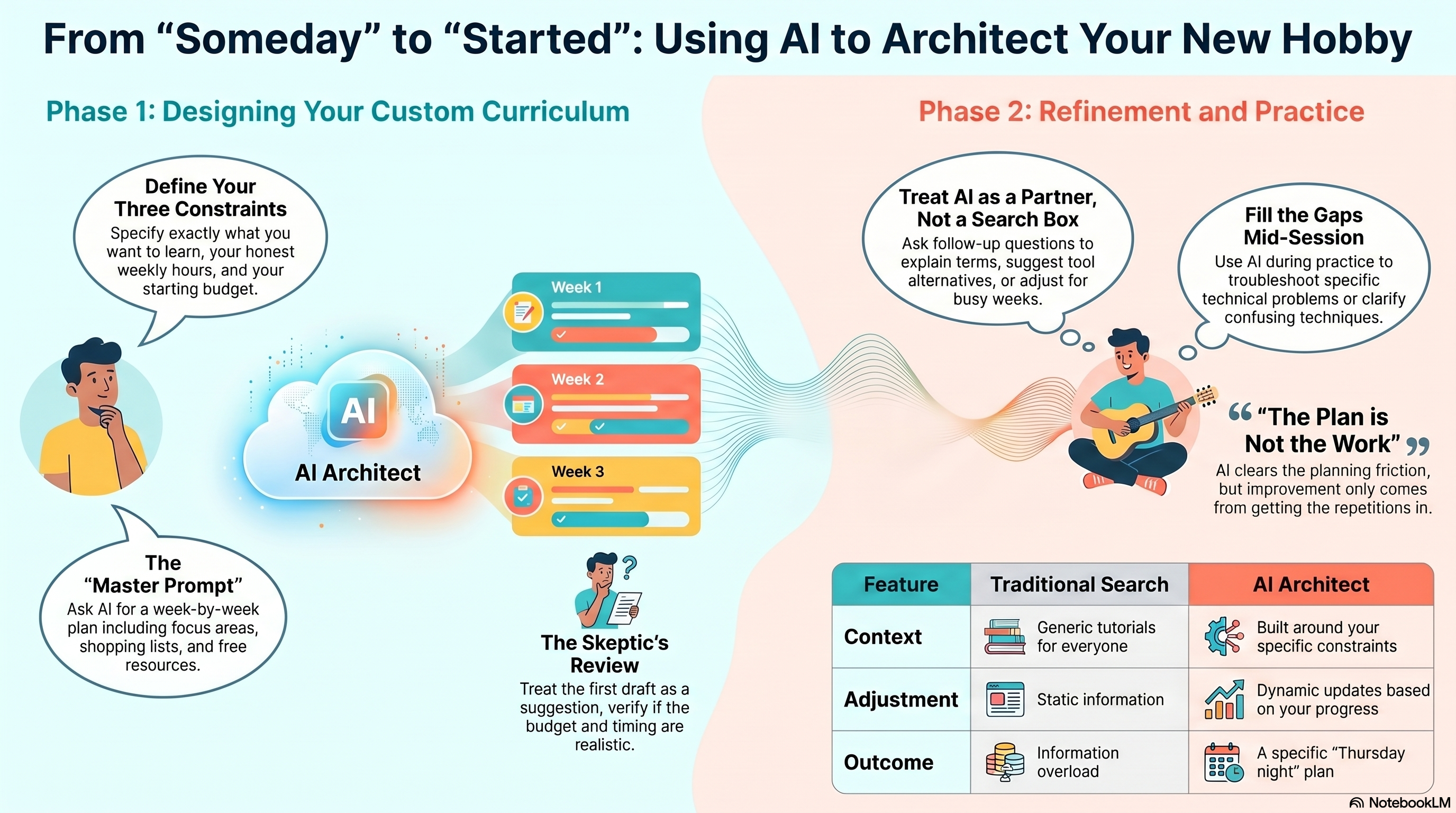
The thing that makes this work is specificity. When you give an AI tool (ChatGPT, Claude, Gemini — pick one) real information about your situation, it stops being a search engine and starts being something closer to a knowledgeable friend who's helping you figure out a plan. The prompt that unlocks this is almost embarrassingly simple. Something like: "I have 3 hours a week and $50. Give me a 4-week plan to learn the basics of wood carving for a total beginner." That's it. That's the move.
Step 1: Get clear on your constraints before you type anything
Before you open an AI app, answer three questions on paper or in your head. First, what specifically do you want to learn? Not "get better at cooking" — something narrower, like "learn to make a few basic Thai dishes from scratch." Second, how much time do you realistically have per week? Not how much you wish you had. Be honest. If it's 90 minutes on a Saturday, say 90 minutes on a Saturday. Third, what's your actual budget for getting started — tools, supplies, a class, whatever that hobby requires?
Those three inputs are what make the AI's response useful instead of generic. Without them, you'll get a wall of text that could apply to anyone. With them, you'll get something that could actually work for you.
If you're not sure what "learning the basics" means for your hobby, just ask the AI that first: "What does a beginner in [hobby] actually need to know in the first month?" Let it define the scope before you ask for the plan.
Step 2: Run the prompt and read the plan like a skeptic
Here's the core prompt to start with — fill in your details: "I want to learn [hobby]. I'm a complete beginner. I have [X hours] a week to practice and a budget of about $[amount] to get started. Can you give me a week-by-week plan for the first 4 weeks, including what I should focus on each week, what I need to buy and in what order, and any free resources worth using?"
What you'll get back is usually a solid first draft of a plan. Week 1 might be "buy these two things, watch this kind of video, and practice this one basic skill for 20 minutes every other day." Week 2 builds on it. It won't be perfect — read it with a critical eye. Does week 1 actually make sense as a starting point, or does it assume you already know something? Is the budget realistic? Does the time breakdown match how your week actually works? Push back on anything that doesn't fit.
Step 3: Ask follow-up questions — that's where it gets good
The plan is just the beginning. The real value shows up when you start treating the AI like a conversation partner rather than a search box. You can ask it to explain any term you don't recognize ("what does 'chip carving' mean exactly?"), suggest alternatives if a recommendation doesn't pan out ("the book you mentioned is out of stock — what else would work?"), or adjust for a week when your schedule falls apart ("I only have 45 minutes this week instead of 3 hours — what's the one thing I should focus on?").
It remembers the whole conversation. You don't have to re-explain your situation every time. Just talk to it like you're picking up where you left off.
After week 1, come back and tell the AI what actually happened: what felt manageable, what didn't, what surprised you. Ask it to adjust the week 2 plan based on that. You'll get something much more useful than the original version.
Step 4: Let it fill in the gaps as you go
Once you're actually in the hobby, the AI becomes a reference you can tap into mid-session. Confused by a technique? Describe what you're doing and ask what you're likely doing wrong. Not sure what to buy next? Ask it to explain the difference between two options before you spend money. Stuck on a specific problem — a chord transition that won't stick, seedlings that keep dying, a cut that keeps splitting the wood? Describe it in plain language and see what comes back.
You're not looking for it to replace a real teacher or a community of people who do this thing. You're using it to fill in the gaps between practice sessions, so you spend less time confused and more time actually doing the thing.
A quick reality check
The best learning plan in the world doesn't help if you don't sit down and practice. The bottleneck in learning a hobby has never been information — it's always been getting the repetitions in. What AI removes is the planning paralysis, that particular kind of friction where you don't know where to start so you never start at all. That part is real, and AI is genuinely good at clearing it. But the plan isn't the work. Don't let building the plan become a substitute for doing the thing. Also worth knowing: AI doesn't have local knowledge. If it suggests a beginner class at a nearby maker space or a community garden with open plots, go verify that yourself. It's making its best guess, not calling ahead.
Your move
Pick one hobby you've been meaning to try. Just one. Open ChatGPT, Claude, or Gemini and paste in the prompt from Step 2 with your actual numbers. Read what comes back. Push back on whatever doesn't fit. You don't have to commit to four weeks — just see what week one looks like. That's a five-minute conversation that turns a vague "someday" into an actual Thursday night plan.