You asked AI a simple question, it answered with total confidence — and every word was wrong.
This is called a hallucination, and it's one of the most talked-about problems with AI tools right now. It's not a bug in the traditional sense, and it's not random glitching. It's something built into how these systems work.
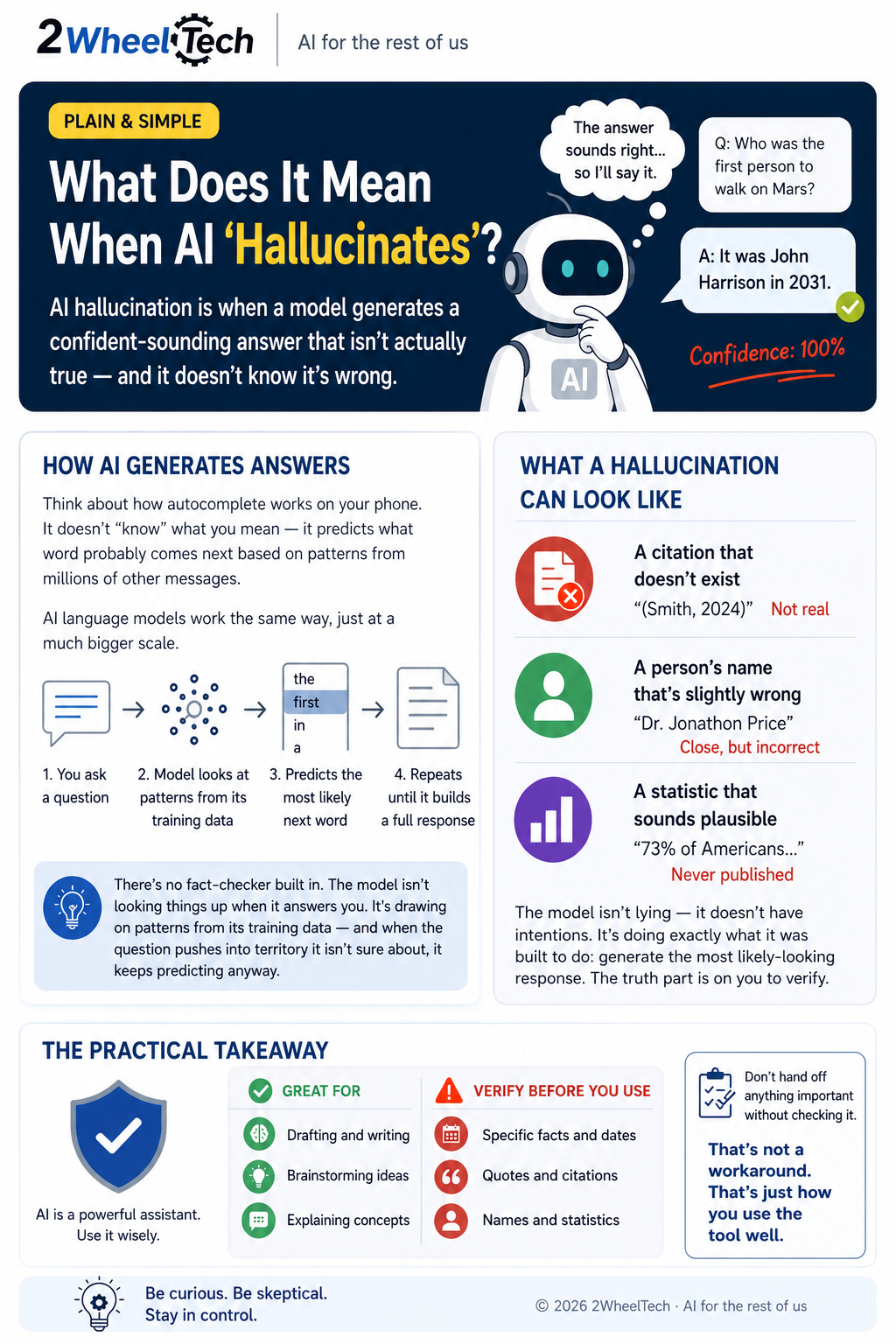
AI hallucination is when a model generates a confident-sounding answer that isn't actually true — and it doesn't know it's wrong.
Think about how autocomplete works on your phone. It doesn't "know" what you mean — it predicts what word probably comes next based on what you've typed and patterns from millions of other messages. AI language models work the same way, just at a much bigger scale. They're predicting the most statistically likely next word, over and over, until they've built a complete response.
That process works well for a lot of things. But there's no fact-checker built in. The model isn't looking things up when it answers you. It's drawing on patterns from its training data — and when the question pushes into territory the model isn't sure about, it keeps predicting anyway. The result looks confident. It reads like a real answer. It just might not be true.
This is why you'll sometimes get an AI response with a citation that doesn't exist, a person's name that's slightly wrong, or a statistic that sounds plausible but was never actually published anywhere. The model isn't lying — it doesn't have intentions. It's doing exactly what it was built to do: generate the most likely-looking response. The truth part is on you to verify.
The practical takeaway is simple: don't hand off anything important without checking it. AI is good at drafting, brainstorming, and explaining concepts. For specific facts, dates, quotes, or citations — verify before you use them. That's not a workaround. That's just how you use the tool well.