By now you've probably seen more than a few of these names — and if you haven't already asked yourself which one you're supposed to be using, someone else has asked you.
ChatGPT, Gemini, Claude, Grok, Perplexity — they're all AI tools that take your questions and respond in plain text. But they come from different companies, were built with different goals, and have genuinely different strengths. The list keeps growing, which makes the question harder, not easier.
These are all AI tools that respond to your questions in plain text. They all work similarly on the surface, but each was built by a different company with different priorities — and those differences show up when you actually use them for real work.
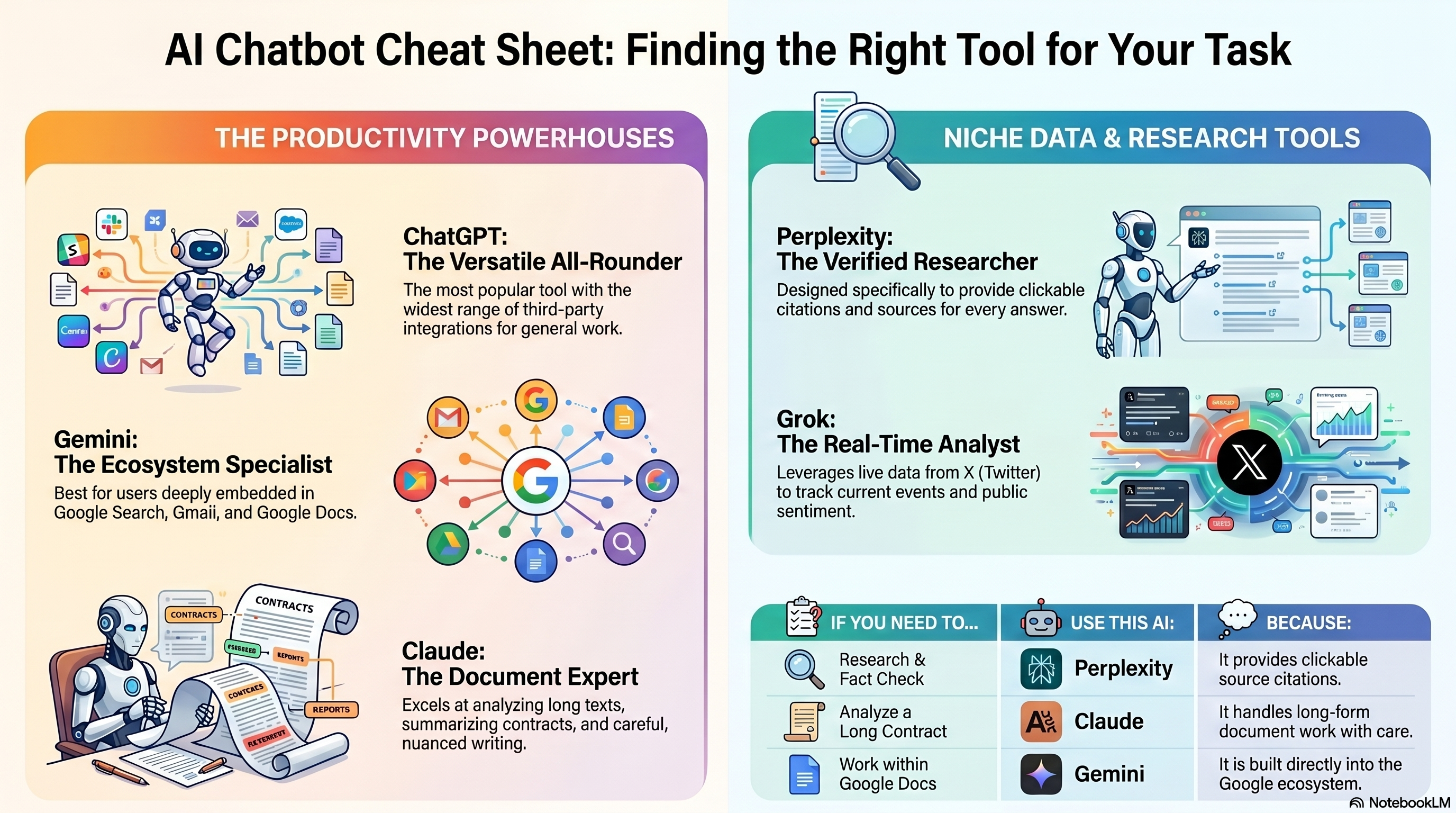
ChatGPT (made by OpenAI) is the one that started the whole conversation. It's been around the longest, has the biggest user base, and the widest range of third-party tools plugged into it. If you've seen someone demoing "AI" at work or on the news, it was probably ChatGPT. It's a solid all-rounder.
Gemini (made by Google) is built into the Google ecosystem — Search, Gmail, Google Docs, even your Android phone. The practical edge there is real: if you live and work in Google's tools, Gemini is already nearby. It also connects to live search results, so it can pull in current information in a way the others don't always do by default.
Claude (made by Anthropic) tends to do well with longer pieces of text — pasting in a contract and asking for a summary, working through a messy email thread, reviewing a draft. It's often a bit more careful in how it phrases things, which some people find more useful and some find slower. Worth trying if you do a lot of writing or document work.
Grok (made by xAI, Elon Musk's company) is built into X (formerly Twitter). Its main angle is real-time access to what's being posted on X, which makes it useful if you want to know what people are saying about something right now. It also tends to be a bit less filtered in its responses, which some people like and others find jarring. If you're not already on X, there's not much pulling you toward it.
Perplexity is a bit different from the others — it was designed from the start to answer questions with sources. Every response comes with citations you can actually click. That makes it a good choice when you want to verify something or need to know where the information came from. It's closer to a research tool than a general-purpose chatbot, and it's good at that job.
For everyday tasks — writing an email, answering a question, brainstorming ideas — most of these will get you somewhere useful. The differences show up when you push them. My advice: don't try to learn all five at once. Pick one that fits where you already spend your time, use it for a week, and switch only if something specific isn't working.
How I actually use them
I lean on Claude for most of my writing and any task that involves working through something on my computer — drafting, editing, summarizing documents, building things. For general questions and quick lookups, Gemini is where I go most often, mostly because it's already woven into the Google tools I use every day.
I also use NotebookLM — a Google tool — for some specific situations where I want to work deeply with a set of documents I've uploaded. It's different enough from these chatbots that it deserves its own post. I'll cover it soon.