I'm not a naturally organized person.
I have a running to-do list with about 40 items on it, roughly 20 of which have been there long enough to qualify as emotional baggage. I know what I need to do. I just have trouble deciding what to do first — and then I get distracted, and then it's 4 PM and I've answered emails and made coffee twice and somehow still haven't done the one thing I actually needed to do that day.
So when I started hearing people talk about using AI to help plan their week, I decided to actually try it. Not for a day. For a month.
Here's what I found — the real version, not the productivity-influencer version where everything works perfectly and you gain three hours a day.
Why I Decided to Try This
A few months ago, I noticed that AI tools like ChatGPT had gotten genuinely useful for writing and research — better than I expected. But planning? That seemed like a stretch. Calendars are personal. Priorities are complicated. How could a chatbot understand what actually mattered to me on any given Tuesday?
Turns out, with a little setup, it can do a surprisingly decent job. Not because it knows you — it doesn't. But because sometimes you need something outside your own head to push back, reorder things, and say "have you considered that you've put 'respond to emails' on your priority list every single day, and it doesn't actually need to be there?"
So I gave it a shot.
How I Set It Up
I didn't use any fancy app or paid tool. Just ChatGPT (the free version works fine for this) and a simple routine each Monday morning.
Here's the basic prompt I started with:
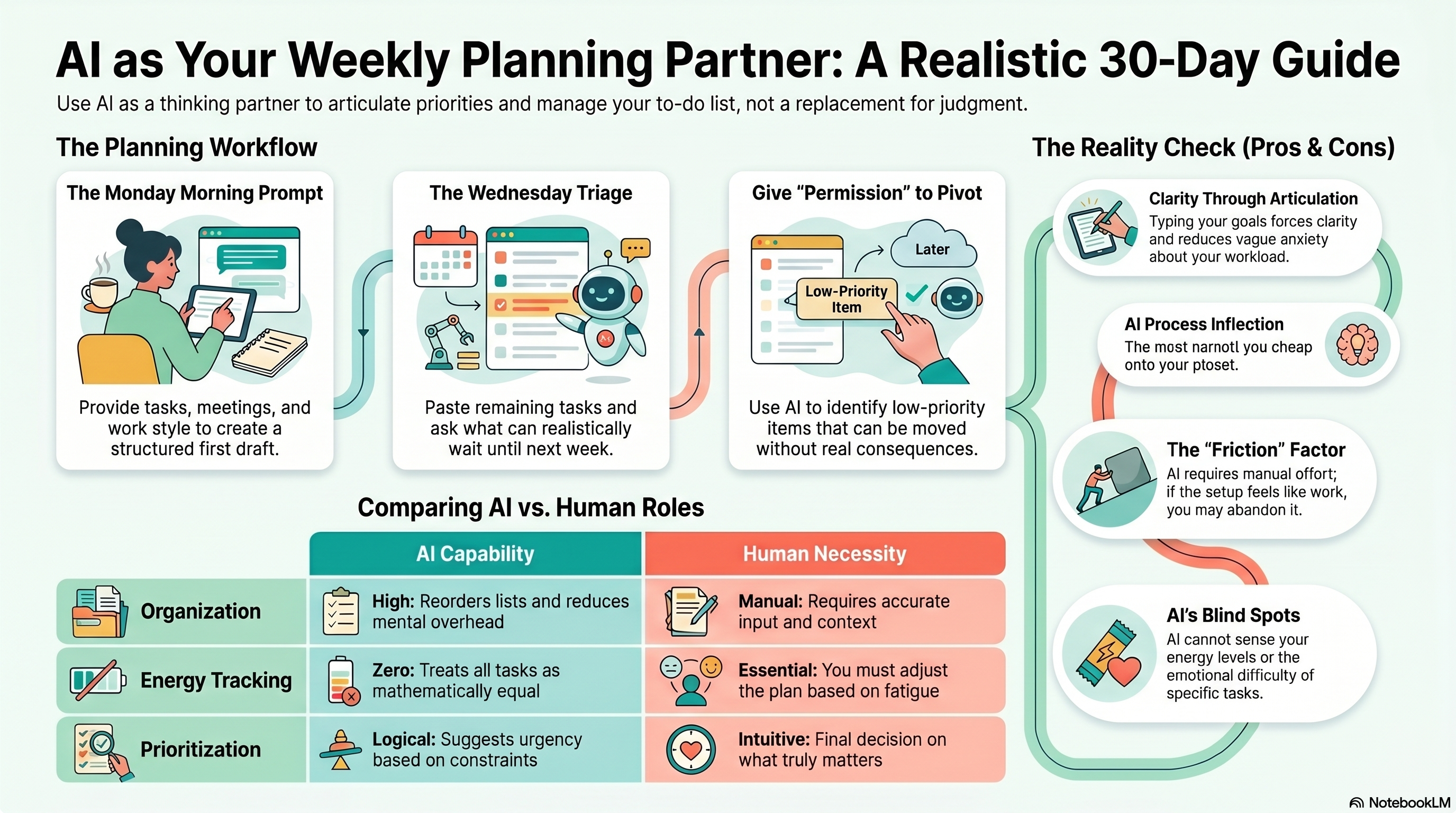
"I have the following tasks this week: [list]. These are my fixed commitments: [meetings, appointments]. I have roughly four focused hours per day. Help me decide what to prioritize and suggest a rough day-by-day plan. I tend to do my best thinking in the mornings."
That last bit matters. The more you tell it about how you actually work — morning person, afternoon person, easily distracted after lunch — the more useful the plan it gives you.
The first week, the output was... fine. Nothing groundbreaking. It basically organized my list in order of urgency, which I probably could have done myself. But here's what surprised me: seeing it laid out clearly, in a plan that wasn't just a jumbled list in my notes app, made me actually follow it. There's something about having a structure handed to you that reduces the mental overhead of deciding what to do next.
What Actually Worked
By week two, I started refining how I asked. I'd drop in my to-do list, describe the week's constraints, and then ask the question that turned out to be the most useful of all:
"Which of these tasks can wait until next week without real consequences? Be honest."
That one question alone saved me hours. There are always items on a to-do list that feel urgent but aren't. When AI told me "finishing the newsletter this week is lower priority than you're treating it — it can move to Thursday or next Monday," it gave me permission to let go of some self-imposed pressure I'd been carrying around for days.
I also started using it mid-week. When Wednesday arrived and I'd inevitably fallen behind on something, I'd paste in what was still undone and ask for help re-prioritizing the back half of the week. That turned out to be the single most useful use case — not grand Monday planning, but Wednesday triage.
On Wednesday afternoon, paste your remaining to-do list into ChatGPT and ask: "Given that I have two days left this week, what should I realistically focus on and what can move to next week?" It's a surprisingly clarifying exercise.
What Didn't Work
AI doesn't know what's actually hard for you.
It treats "respond to seven emails" and "write a difficult message to a client you're frustrated with" as equivalent tasks. They are not. One takes ten minutes. The other takes forty-five minutes and a snack.
It also has no idea about your energy. It can't tell that you're running on four hours of sleep, or that you've got a lot on your mind, or that you really just need to accomplish two things today and call it a win. You have to provide that context yourself — every single time. And some weeks, you just don't want to do that.
There were a couple of weeks where I skipped the whole routine because it felt like extra work. And honestly, that's a signal worth paying attention to. Tools that add friction eventually get abandoned. This one does require some upfront effort to be useful.
The Honest Take
AI didn't fix my planning. It gave me a starting point and a thinking partner that pushed back on my assumptions. That's genuinely valuable — but it's not the same as being organized.
What it did do: made me articulate my priorities out loud (or out-typed), which forced me to actually think about them instead of just carrying them around as vague anxiety. That part worked every time I used it.
What it didn't do: know me, anticipate my energy, understand office dynamics, or care that I really did not want to make that phone call Tuesday morning. That stuff is still on you.
Want to Try It?
Start small. Next Monday morning, open ChatGPT and type out your task list and your non-negotiable commitments for the week. Ask it to help you prioritize. See what comes back.
Then — and this part matters — don't follow it blindly. Use it as a first draft. Move things around. Trust your gut about what you actually have capacity for. Think of it as a planning assistant, not a planner.
It won't transform your week. But it might help you start it with a little more clarity and a little less "okay, where was I?"
And sometimes, that's enough.