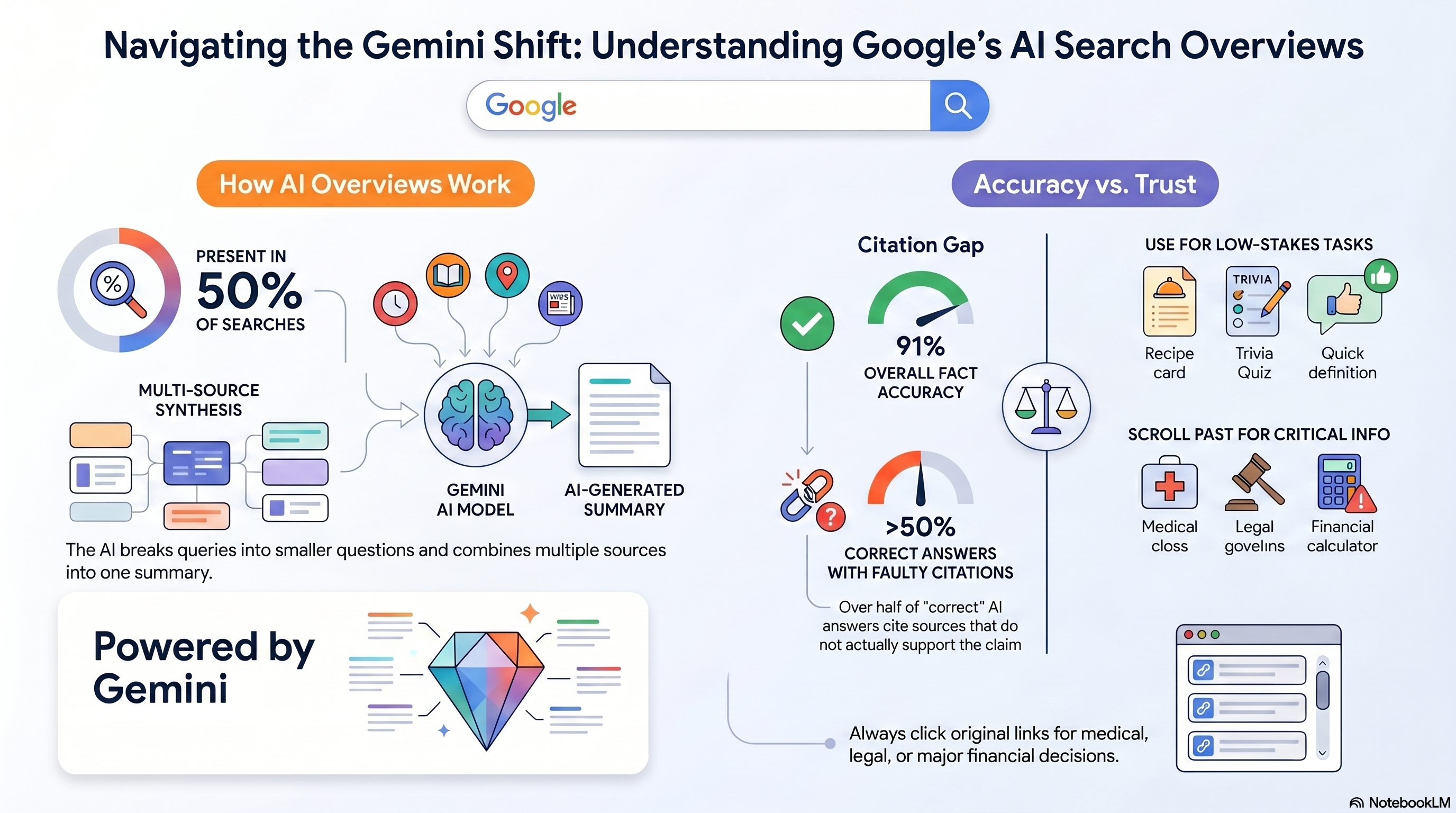
If you've searched for something on Google recently and noticed a big box of text at the very top — before the links — that's not an ad. That's Google's AI answering your question directly.
Google calls this feature AI Overviews. It rolled out to U.S. users in 2024 and has been expanding ever since. The idea is simple: instead of showing you a list of links and making you click through to find an answer, Google now tries to give you the answer itself — written out in plain sentences, right there on the results page.
Here's how it works in practice. You type in a question — say, "how long does it take for grass seed to germinate?" — and before you even see a single website link, you get a short paragraph summarizing the answer. Google's AI has read through dozens of websites and is giving you a condensed version of what they say, with little citations at the bottom if you want to trace where the information came from.
It genuinely is faster for a lot of questions. How-to queries, quick facts, comparisons — the AI box often saves you three or four clicks.
For everyday questions, you'll often get your answer without leaving Google — but for medical, legal, or financial questions, click through to a real source anyway.
The catch — and this is worth knowing — is that the AI is not always right. It has made some memorably wrong answers since launching, including some that went viral for being flat-out incorrect. Google has improved it, but it still makes mistakes, especially on nuanced topics or recent events.
Think of the AI summary as a starting point, not the final word. For something simple like a recipe substitution or a general how-to, it's usually solid. For anything that really matters — health decisions, legal situations, major purchases — scroll past it and read the actual websites.
The links are still there. Google didn't get rid of them. They're just a little further down the page now.